Confidence Intervals
Lesson 20
Packages
Make sure these are attached:
Confidence Intervals for Parameters
Hill-Racing
How does winning time depend on distance and climb?
Model Equation
\[\text{time} = a + b_1 \times \text{distance} + b_2 \times \text{climb} + N(0,\sigma).\]
Confidence Intervals
# A tibble: 3 × 4
  term           .lwr   .coef    .upr
  <chr>         <dbl>   <dbl>   <dbl>
1 (Intercept) -533.   -470.   -407.
2 distance     246.    254.    261.
3 climb          2.49    2.61    2.73
These are 95%-confidence intervals for their respective parameters.
How are they made?
Model Summary
# A tibble: 3 × 5
  term        estimate std.error statistic   p.value
  <chr>          <dbl>     <dbl>     <dbl>     <dbl>
1 (Intercept)  -470.     32.4        -14.5 9.92e- 46
2 distance      254.      3.78        67.1 0
3 climb 2.61 0.0594 43.9 4.08e-304std.erroris an attempt to estimate the standard deviation of the parameter-estimate.- It measures the amount by which the estimate could easily differ from the value of the unknown parameter.
For Example …
# A tibble: 1 × 5
  term     estimate std.error statistic p.value
  <chr>       <dbl>     <dbl>     <dbl>   <dbl>
1 distance 254. 3.78 67.1 0- We estimate that for each additional kilometer, the mean winning time increases by 253.8 seconds.
- But this estimate could easily by off from the unknown parameter \(b_1\) by 3.78 sec/km or so.
Comparison
# A tibble: 1 × 4
  term      .lwr .coef  .upr
  <chr>    <dbl> <dbl> <dbl>
1 distance  246.  254.  261.
Compare with:
Interpretation
We say:
We are 95%-confident that the mean increase in winning time associated with an additional kilometer of ditance is somewhere between 246 and 261 seconds per kilomter.
95%-Confident
What does it mean that we are 95%-confident? It means that:
The interval was computed by a formula designed so that in repeated sampling the interval produced would cover the true value of the parameter 95% of the time.
Verify This with Simulation
Imagine that the real-world data-generating process works like this:
Try It Out
Try this a few times:
The true value of \(b_1\) is 254. Usually the confidence interval contains this value.
Sample Many Times
Compute Coverage-Percentage
Making Decisions With Confidence Intervals
Is it Plausible …
… that the mean increase in winning time for each additional kilometer is less than 240 seconds?
Well, …
… the 95%-confidence interval for \(b_1\) is:
# A tibble: 1 × 4
  term      .lwr .coef  .upr
  <chr>    <dbl> <dbl> <dbl>
1 distance  246.  254.  261.
240 lies below that interval. So, based on the data we have, it’s not plausible that \(b_1\) could be that low.
Is it Plausible …
… that the mean increase in winning time for each additional kilometer is less than 250 seconds?
Well, …
… the 95%-confidence interval for \(b_1\) is:
# A tibble: 1 × 4
  term      .lwr .coef  .upr
  <chr>    <dbl> <dbl> <dbl>
1 distance  246.  254.  261.
250 lies within that interval. So, based on the data we have, it’s plausible that \(b_1\) could be that low.
Is it Plauasible …
… that the mean increase in winning time for each additional meter of climb is more than 3 seconds?
Well, …
… the 95%-confidence interval for \(b_2\) is:
# A tibble: 1 × 4
  term   .lwr .coef  .upr
  <chr> <dbl> <dbl> <dbl>
1 climb  2.49  2.61  2.73
3 lies above that interval. So, based on the data we have, it’s not plausible that \(b_2\) could be that high.
Is it Plauasible …
… that the mean increase in winning time for each additional meter of climb is more than 2.6 seconds?
Well, …
… the 95%-confidence interval for \(b_2\) is:
# A tibble: 1 × 4
  term   .lwr .coef  .upr
  <chr> <dbl> <dbl> <dbl>
1 climb  2.49  2.61  2.73
2.6 lies within that interval. So, based on the data we have, it’s plausible that \(b_2\) could be that high.
Confidence Intervals By Resampling
A Model Assumption
\[\text{time} = a + b_1 \times \text{distance} + b_2 \times \text{climb} + N(0,\sigma).\]
It was assumed that the noise is normally distributed, with a fixed standard deviation, no matter what the distance and climb are.
Residuals
A residual is the difference between the fitted value for the y-variable and the actual y-value in the data.
The trained model chooses its coefficients so that the sum of the squares of the residuals is as small as possible.
Finding the Residuals
Plot the Residuals
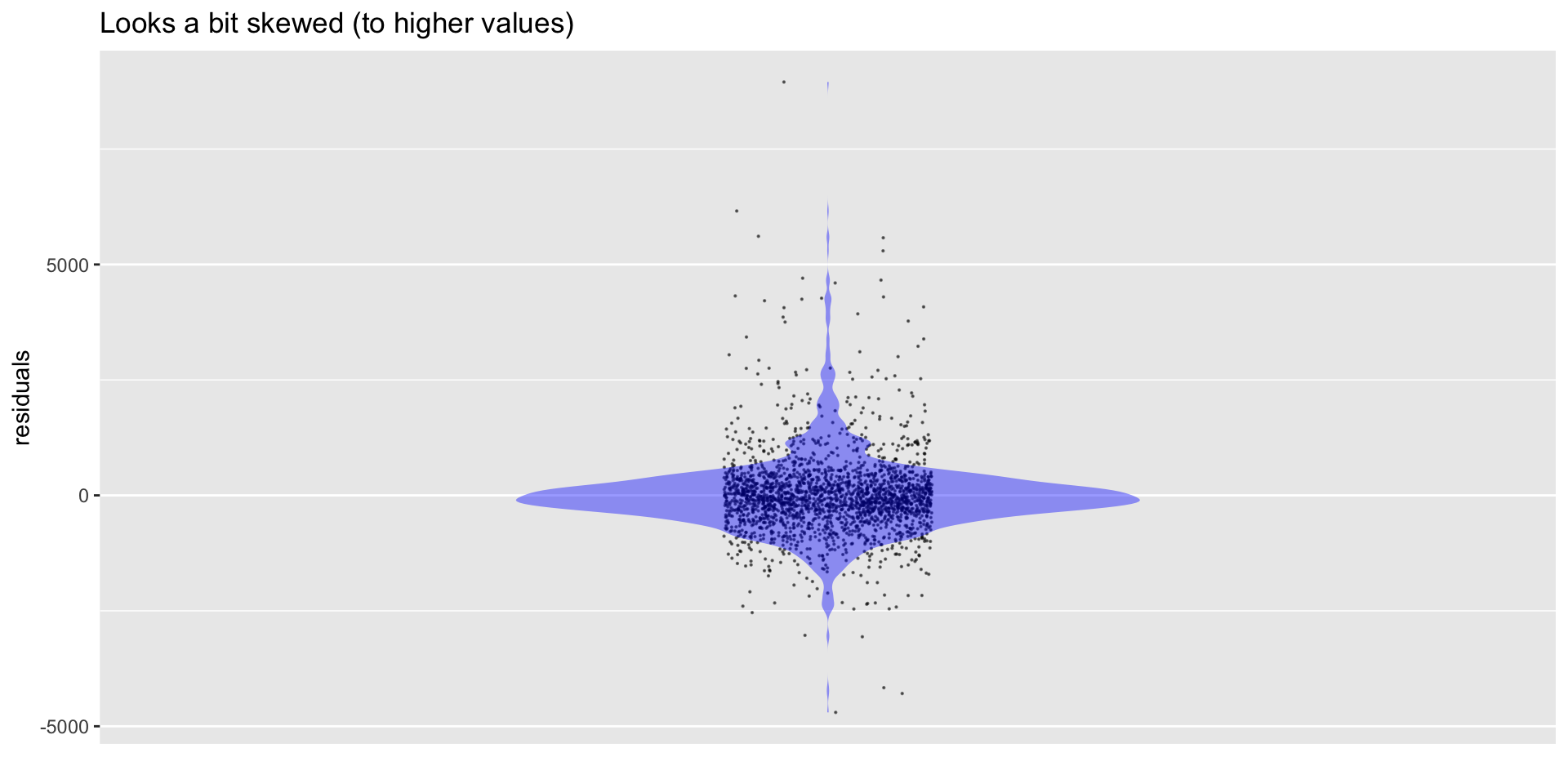
Plot Residuals vs. Fitted Values
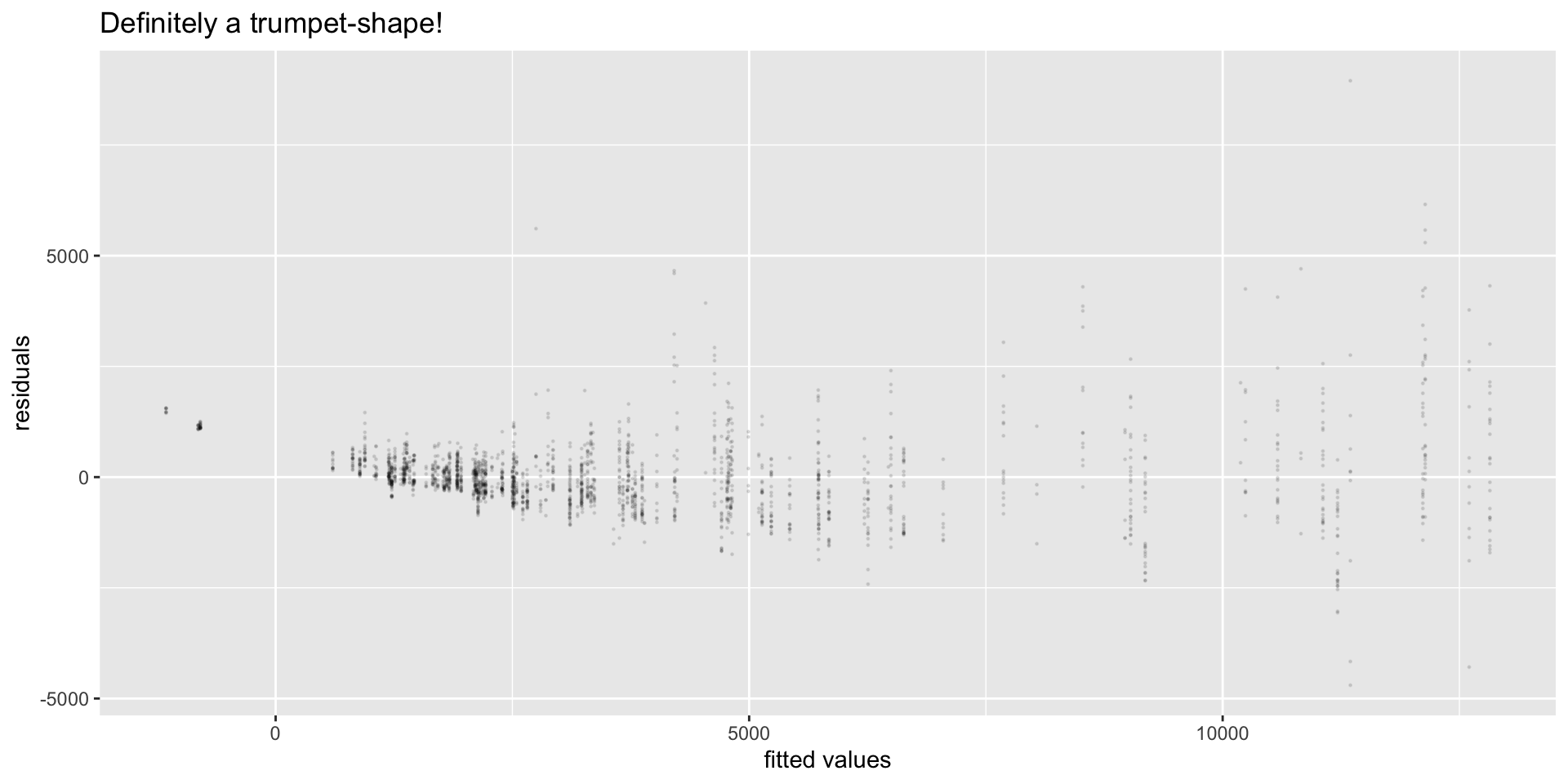
The Model Assumption …
… that the noise is normally distributed, with a fixed standard deviation, no matter what the distance and climb are …
might not be realistic!
Resampling: a Robust Method
When we cannot trust the model assumptions, we can try to make a confidence interval by resampling.
Resample
Get Percentiles
Compare with the normal-noise-based interval:
# A tibble: 1 × 4
  term      .lwr .coef  .upr
  <chr>    <dbl> <dbl> <dbl>
1 distance  246.  254.  261.
This procedure …
… is called the “percentile” bootstrap.